
Mesotherapy in Brighton: What Skin Mesotherapy Can and Cannot Do

Updated: Oct 8
Mesotherapy is one of the oldest treatments still on modern aesthetic menus, and one of the most loosely defined. The word describes a delivery method, not a specific product — which is why two clinics can both offer "mesotherapy" and give you completely different treatments at completely different prices.
So the useful question is never "should I have mesotherapy?" It is "what is in the syringe, how deep is it going, and what is that combination supposed to change?"
What mesotherapy actually is
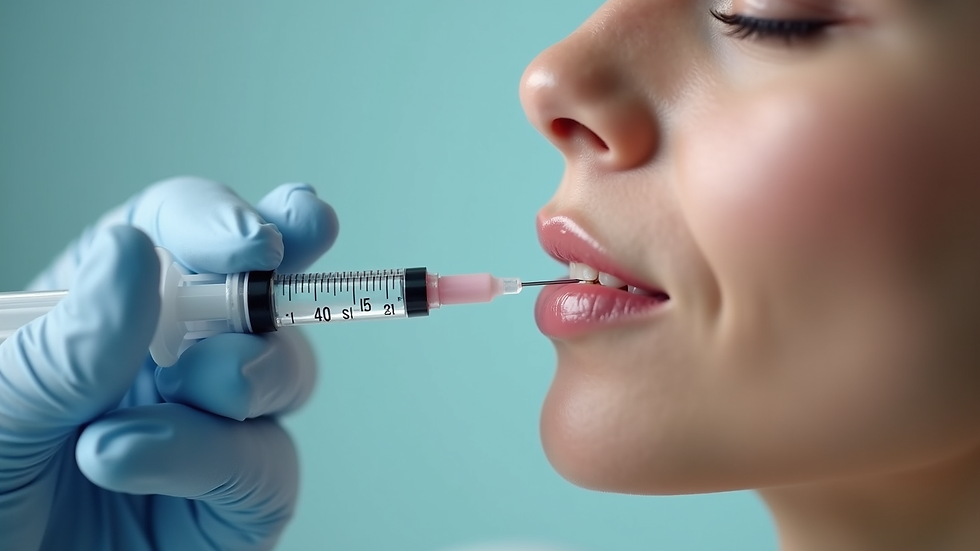
Mesotherapy means delivering active ingredients directly into the skin through a series of small, shallow injections, rather than relying on a cream to penetrate from the surface. The formulation — often called a cocktail — is chosen for the concern and typically contains some combination of:
Non-cross-linked hyaluronic acid for hydration;
Vitamins, especially B-complex and vitamin C;
Amino acids, the raw material for collagen and elastin;
Peptides and coenzymes for cell signalling and energy;
Minerals and antioxidants to reduce oxidative stress;
Targeted actives such as tranexamic acid for pigmentation, or biotin and growth-factor blends for the scalp.
The logic is simple: the skin barrier does its job extremely well, and most of what you apply topically never reaches the dermis in a meaningful concentration. Mesotherapy skips the barrier.
What it realistically improves
Mesotherapy is a skin-conditioning treatment. Where it earns its place:
Dullness and dehydration — the "tired skin" complaint, particularly in winter or after a period of poor sleep and stress.
Fine surface lines caused by dryness rather than by volume loss.
Uneven tone and early pigmentation, with the right cocktail.
Oily and congestion-prone skin — some formulations help regulate sebum and calm inflammation alongside a proper acne treatment plan.
Neck, décolletage and hands, where skin is thin and neglected.
Hair thinning — scalp mesotherapy as an adjunct to medical management, not a replacement for it.
What it does not do: it does not lift, it does not restore volume, and it does not remove wrinkles that are caused by muscle movement or by lost structural support. If someone tells you mesotherapy will replace a filler or a collagen biostimulator, they are describing a different treatment.
How the treatment is done
There are two honest versions of mesotherapy and one that is oversold.
Needle mesotherapy uses a very fine needle to place 50 to 100 microinjections across the treatment area, reaching the upper dermis. This delivers the highest concentration where it is useful and is the version most clinical claims are based on.
Microneedling-assisted mesotherapy creates controlled micro-channels and drives the cocktail through them. It is comfortable, it covers larger areas quickly, and it adds a collagen stimulus of its own.
Needle-free "electroporation" mesotherapy is pleasant and has no downtime, but penetration is shallower and the results are correspondingly lighter. It is a facial with a good delivery system — not a substitute for injected treatment, and it should not be priced as one.
A session takes 30 to 45 minutes including numbing cream.
The course, and when you will see something
Mesotherapy is a cumulative treatment. A realistic course is four to six sessions, one to two weeks apart, with maintenance every three to six months.
Most patients notice a change in radiance and hydration after the first or second session. The fuller effect — texture, tone, that "well" look — lands around two to four weeks after finishing the initial series and typically holds for three to six months. It fades if you stop, because you are conditioning skin rather than restructuring it.
A note on cost. Judge mesotherapy on the price of the course, not the price of a session. A £120 single session that needs six repeats is not cheaper than a £250 treatment that needs three. Ask which product is being used and how many sessions the plan involves before you compare clinics.
Downtime and side effects
Expect small raised bumps at the injection points for a few hours, mild redness for a day, and occasional pinpoint bruising. Leave make-up off for 12 to 24 hours and skip the gym, sauna, sunbed and alcohol for the first day.
Serious problems are uncommon but real: infection where sterility is poor, allergic reaction to one component of a cocktail, and pigment changes in richly pigmented skin if the technique is too aggressive. Because mesotherapy blends multiple actives, a full allergy history matters more here than with a single-ingredient injectable.
Mesotherapy is not suitable in pregnancy or breastfeeding, with active infection or inflamed lesions in the area, in poorly controlled bleeding disorders or anticoagulation, or where a previous adverse reaction to a similar cocktail has occurred.
Mesotherapy versus skin boosters versus polynucleotides
Patients ask this constantly, so here is the short version.
Mesotherapy: many actives, tailored, superficial, quick to show, shorter-lived. Best for condition, glow and skin health.
Skin boosters: mostly hyaluronic acid at high concentration, standardised, deeper. Best for sustained hydration and mild firmness.
Polynucleotides: a regenerative signal to fibroblasts. Slowest to show, longest to last, best for thin and crepey skin — particularly under the eyes.
They are not competitors so much as different tools. A sensible plan often uses mesotherapy to get skin into good condition and a regenerative injectable to change its baseline quality.
Choosing a clinic for mesotherapy
Because the word covers such a wide range of practice, mesotherapy is one of the easiest treatments to buy badly. Four questions sort most of it out.
What product are you using, by name? A clinic should be able to tell you the brand and what is in it. "Our own blend" is not an answer.
Is it injected, or needle-free? Both are legitimate — but they are not the same treatment and should not carry the same price.
How many sessions, and what happens after the course? A plan with no maintenance schedule is a plan that has not been thought through.
Who is performing it? Injecting into the dermis is a medical procedure with medical risks, and the person holding the needle should be qualified to manage a complication, not just to cause one.
It is also fair to ask what the clinic expects mesotherapy to achieve for your face specifically. If the answer is generic, the treatment plan probably is too.
Common questions
Does mesotherapy hurt?
With numbing cream it is very tolerable — a series of light scratches. The forehead and around the eyes are the more sensitive areas.
How soon can I have it before an event?
Allow at least five to seven days. The glow arrives after the redness leaves, and occasional bruising is unpredictable.
Is mesotherapy worth it if I already have a good skincare routine?
Often yes — but the routine comes first. Mesotherapy on top of a good regimen amplifies it; mesotherapy instead of one is an expensive way to avoid buying a sunscreen.
Can mesotherapy help hair loss?
It can support a medical plan by improving the scalp environment, but the cause of the hair loss has to be diagnosed first. Treating the scalp without knowing why it is thinning wastes both time and money.
Mesotherapy at Dr Selvi Clinic, Brighton
We will tell you what your skin needs, in what order — and what it does not need yet. See current fees on our pricing page, or book a free initial consultation at 57B London Road, Brighton.
Comments